
Counselling Notes
Tier 1 of the response model: a written record that the employee was told — before anything becomes a case.
Why this exists (and why "verbal warning" doesn't)
Managers reach for a "verbal warning" for first lapses. But a verbal warning is a contradiction: if it is to matter later ("we told you in March"), it must be written down — and once written, it is a record. AstraHR names it honestly: a counselling note. It is:
- not a sanction — nothing is imposed;
- not appealable — there is nothing to appeal;
- not in appraisals;
- evidence of prior notice — it counts at the tier-1→2 boundary while valid, where an escalation rule says so.
Raising one (manager / HR)
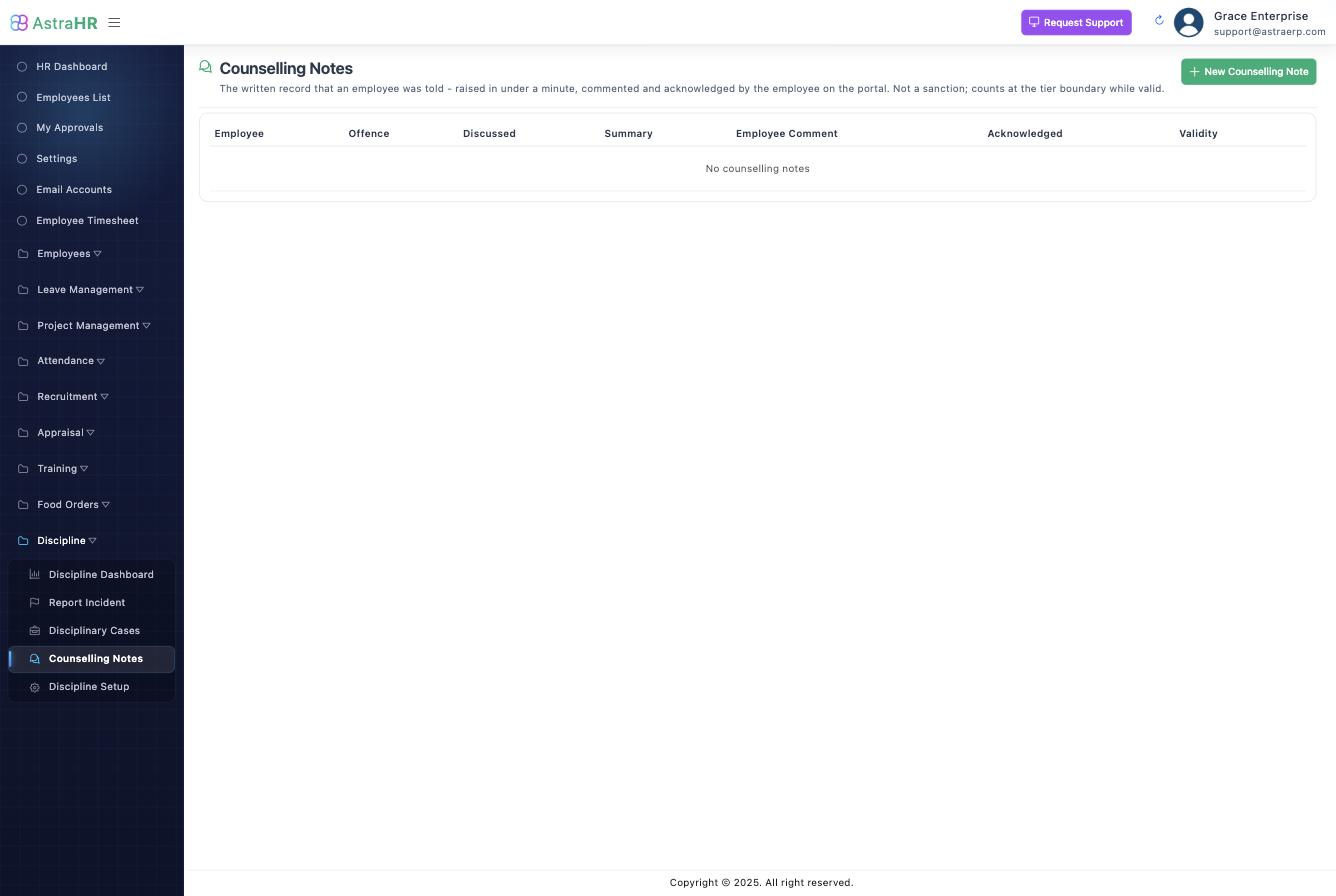
HR → Discipline → Counselling Notes → New. Under a minute:
- Employee, optional offence from the catalogue, incident date, discussed-on date (defaults today; discussed by defaults to the employee's manager).
- What was discussed — the summary, in plain words.
- Validity in months (default 6) — after this the note is spent and stops counting.
The employee's half
On their portal the employee sees the note and:
- adds their own comment — typed by them, never by the manager. That distinction is the note's integrity: it captures both sides in each side's own words;
- acknowledges that the conversation happened — or declines, and the refusal itself is recorded.
Once the employee has commented or acknowledged, the note is locked — the manager can no longer edit it.
Life of a note
When to use which tier
| Situation | Right tool |
|---|---|
| First missed timesheet, first lateness | Nothing, or a nudge |
| Repeat minor lapse; a real conversation happened | Counselling note |
| Lapse persists after a note; or any major/gross matter | Formal case |